
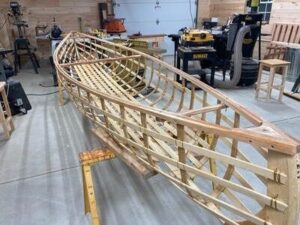
Living Engineering Along the Essex River
Along the waterways of Massachusetts, the Chebacco boat and the Essex schooner represent more than a recognizable coastal style. They embody a working method in which a vessel is shaped by local waters, available timber, practical cargo requirements, and the judgment of the shipwright. The tradition remains visible in Essex, where the preservation of wooden vessels is tied to active design, repair, education, and hands-on construction rather than display alone. Deep within the historic maritime corridor recognized across the Essex National Heritage Area, local shipwrights maintain full-scale manual timber craft.
What makes this work technically valuable is the marriage of old geometry and modern preservation discipline. An eighteenth-century half-hull model can still establish the logic of a vessel, while full-size lofting, measured patterns, moisture assessment, and careful documentation make that logic repeatable. Inside an Essex yard, timber selection and manual tooling converge in a sequence of controlled decisions: a curve is found in the wood, a line is transferred to the lofting floor, a joint is fitted, and the completed structure is tested by the forces of the sea.
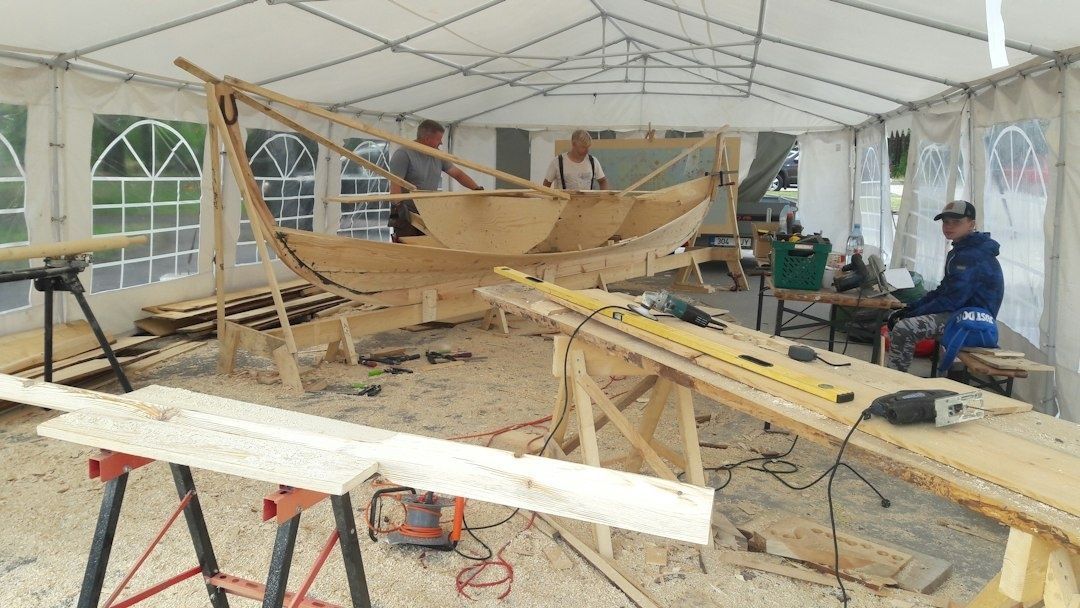
Full-Scale Lofting and Half-Hull Geometry
Traditional design often begins with a small carved half-hull model. The model is not merely a decorative miniature. It is a three-dimensional record of the vessel”s intended form, including the relationship between keel, stem, stern, frames, waterlines, and sheer. By taking measurements from the model at regular stations, a shipwright can expand the geometry to full size on a lofting floor. This process turns a compact physical object into a working plan that can guide the construction of backbone timbers and frames.
Full-scale lofting is valuable because it exposes errors before expensive timber is cut. Instead of relying on a collection of isolated measurements, the builder draws the hull as a connected system. Waterlines show the vessel”s horizontal sections, buttock lines reveal vertical longitudinal sections, and the sheer profile describes the rise of the deck and gunwale from bow to stern. Each view must agree with the others. A discrepancy in one line can produce an unfair hull, an uneven plank run, or a frame that does not meet the intended surface.
Flexible battens, often called splines, help the shipwright fair these lines. A batten is bent through a series of measured points, and its natural curve reveals whether the points form a smooth transition or an unwanted hard spot. This is a practical form of engineering judgment. The goal is not to force a mathematical curve into place, but to create a continuous shape that can be built in timber and will behave predictably in water.
- Waterlines establish horizontal hull sections and help check displacement-related geometry.
- Buttock lines reveal how the hull changes from centerline toward the sides.
- Sheer lines define the longitudinal rise of the deck and upper hull.
- Patterns transfer the verified geometry to stems, floors, frames, and other backbone components.
Once the lofting lines are fair, the yard can produce physical patterns from wood, Mylar, or other stable sheet material. These patterns are especially useful for backbone timbers because they preserve the exact shape while the stock is selected and prepared. A pattern also provides a durable reference during repair, allowing a later shipwright to distinguish an original design feature from distortion caused by age, loading, or previous work.
Selecting Native Timber and Urban Wood Reclamation
Wood selection begins with the intended structural role, not simply the species name. White oak is valued for frames, floors, knees, and planking because it combines strength, shock resistance, and useful bending characteristics. Black locust offers exceptional durability for parts exposed to fastening loads and moisture. Clear white pine, where appropriate, provides workable stock for lighter components and planking. Hackmatack, or tamarack, is particularly useful when naturally curved knees are available, because a naturally grown curve can carry load more efficiently than a sharp angle cut across straight-grained stock.
Regional reclamation adds another layer of technical judgment. The Essex Shipbuilding Museum’s wood reclamation program obtains logs from local tree-care companies removing trees from residential properties. The program does not remove trees for lumber. Instead, it accepts suitable material that would otherwise become waste, then assesses each log for straightness, defects, diameter, moisture, and grain direction. Straight sections may become keels, frames, or planks, while naturally curved sections are reserved for knees and other shaped components.
This approach keeps material local and makes the log”s natural structure part of the design process. Oversized logs may be split by hand to follow the grain rather than being forced through a saw pattern that creates unnecessary runout. Even offcuts can serve a purpose, including fuel for steam-bending barrels. Preservation initiatives associated with organizations such as the Essex Shipbuilding Museum show how reclaimed native timbers can support traditional coastal fleets, apprenticeships, and student workshops.
| Timber consideration | Why it matters in construction |
|---|---|
| Grain alignment | Long, continuous grain generally improves strength and reduces the risk of splitting along loaded members. |
| Moisture profile | Wood that is too dry may fracture during bending, while uneven moisture can produce distortion and unpredictable shrinkage. |
| Natural curvature | Curved grain can make knees and grown frames stronger than equivalent shapes cut from straight stock. |
| Rot resistance | Durable species are better suited to fastener zones, bilges, exterior planking, and other persistently damp locations. |
| Defect assessment | Knots, shakes, reaction wood, and decay must be evaluated against the loads expected in the finished vessel. |
Moisture management is as important as species selection. A plank or frame should be examined for internal variation, not just surface dryness. Material intended for steam bending must retain sufficient moisture and must be heated evenly. Conversely, timber installed with excessive or uneven moisture can shrink after assembly, opening seams or reducing fastener tightness. Practical shipbuilding therefore treats the log as a structural resource with a history, not as anonymous boards with identical properties.
The Science of Steam-Bending White Oak Planking
Steam bending works because heat and moisture temporarily make wood more pliable. In a steam chamber, the cell walls absorb heat and water, and the lignin and hemicellulose that help bind the wood”s cellulose fibers become more flexible. The process does not turn oak into a permanently soft material. It creates a limited working window in which the plank can be bent around a mold, frame, or former before it cools and stiffens.
Time and temperature must be treated as controlled variables. The thickest part of the stock determines how long the heat must penetrate. Surface steaming alone can create a dangerous false impression of readiness, leaving the core too cool to bend. A shipwright also studies grain direction, knots, and runout before placing the piece in the chamber. These features can concentrate stress and cause rupture when the bend is applied.
- Prepare the stock. Confirm dimensions, grain direction, end condition, and moisture. Remove sharp damage that could become a crack initiator.
- Heat evenly. Place the oak in the steam chamber with enough exposure for heat to reach the core. Avoid relying on a fixed time without considering thickness.
- Set the former. Have clamps, straps, molds, and blocking ready before the timber exits the chamber. The bending operation must proceed without delay.
- Apply controlled pressure. Bend progressively, keeping the grain supported and avoiding sudden point loads. Clamp pressure should hold the shape without crushing the fibers.
- Align the joint. If the piece includes a scarf or must meet another plank, maintain the intended bearing and alignment while the timber is still flexible.
- Allow cooling and drying. Keep the piece restrained until it has cooled thoroughly and approached a stable moisture condition before final fitting.
Springback is normal because the wood retains some elastic memory. The allowance must be understood rather than guessed. A bend that appears correct immediately after clamping may relax as the stock cools, while an over-tightened setup can crush fibers and weaken the part. The practical solution is to use test pieces when the bend is critical, record the result, and adjust the former or restraint method accordingly.
Grain rupture usually points to one of several problems: insufficient heat penetration, excessive bend radius, unsuitable grain, inadequate support, or a bend applied too quickly. Moisture equilibrium also matters after installation. A plank that dries rapidly can shrink across its width and stress seams, while a piece that remains wetter than surrounding material may later pull away from fasteners. Successful steam bending is therefore not a single heating event. It is a chain of decisions extending from timber preparation through cooling, fitting, fastening, and final acclimatization.
Trunnels and Fasteners in Heavy Timber Assemblies
Trunnels, also called tree-nails, are wooden fasteners used to bind frames, planks, knees, and other structural members. Black locust is particularly suitable because it is strong, durable, and resistant to decay when properly selected. A trunnel is shaped with a controlled taper or working profile, driven through accurately aligned holes, and secured so that it acts as a structural member rather than a decorative imitation of one.
The key mechanical advantage comes from moisture response. Wood is hygroscopic, meaning it exchanges moisture with the surrounding air and structure. A dry trunnel driven into a prepared hole can absorb moisture and swell, tightening its grip within the assembly. Cross-wedging at the end of the trunnel expands the fastener locally and helps lock it in place. The result is a joint that can remain tight while allowing the surrounding wooden structure to move in a measured, compatible way.
- Use straight-grained fastener stock with no hidden checks or weak cross grain.
- Orient holes carefully so the trunnel passes through the intended structural members.
- Drive the fastener without splitting the surrounding plank or frame.
- Use cross-wedges that expand the end without creating excessive local stress.
- Inspect the joint after swelling, movement, and seasonal moisture changes.
Traditional joinery does not mean every modern fastener must be rejected. Ocean-going or heavily loaded vessels may use targeted bronze drift bolts where additional clamping force, corrosion resistance, or long-term reliability is required. The important principle is balance. Bronze should reinforce a carefully fitted wooden assembly, not compensate for poor bearing surfaces, misaligned holes, or inadequate timber. A shipwright evaluates the load path first, then chooses the fastening method that preserves the structure”s ability to move without losing integrity.
Maintenance also depends on understanding how wood and metal interact. Bronze is generally favored over ferrous metals in many marine applications because it resists corrosion, but its use still requires attention to grain, edge distance, and moisture. Trunnels, bolts, caulking, and scarf joints each perform differently as the hull flexes. Regular inspection should look for open seams, crushed wood around fasteners, localized discoloration, softening, and changes in alignment. Those symptoms often reveal a developing structural problem before it becomes a major repair.
Keeping Historic Maritime Engineering Seaworthy
Essex craftsmanship endures because it connects historical fleets with present-day marine trades. Lofting, timber reclamation, steam bending, and trunnel joinery are not isolated heritage demonstrations. Together, they form a working system for producing and repairing vessels that must tolerate impact, vibration, changing moisture, and repeated loading. The methods remain credible because they are judged by fit, strength, service life, and the vessel”s behavior afloat.
For woodworkers and marine preservationists, the practical next step is to treat every traditional detail as applied mechanics. Document the original geometry before dismantling. Select timber by grain and moisture as well as species. Test difficult bends, allow restrained components to cool fully, and inspect fastener zones as part of routine maintenance. When these habits are combined with skilled manual tooling, a wooden vessel becomes more than a preserved object. It remains a clear signal of durable engineering, capable of carrying Essex knowledge into another generation.